

Twenty-five years ago, the O. B. Lulu-Briggs Foundation began with a programme focused on vulnerable older people. Today, the organisation says its work has expanded across healthcare, education, elderly care, livelihoods, water and sanitation, access to justice and humanitarian assistance, with an estimated 2.12 million people reached over the past quarter-century.
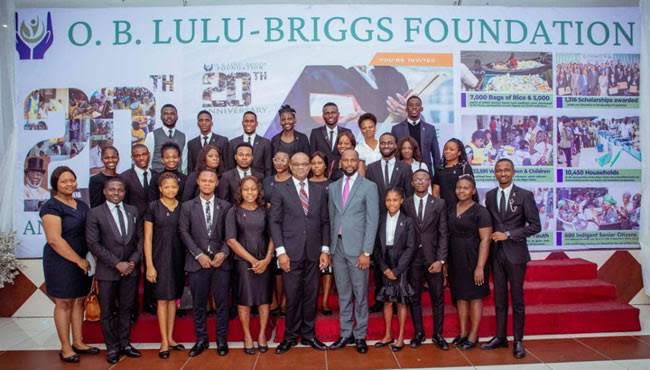
The Foundation marked its 25th anniversary, or Silver Jubilee, in Port Harcourt, Rivers State, with a series of activities that included its 50th Free Medical Mission, a thanksgiving service and a conference focused on ageing, dementia and brain health.
According to figures presented by the Foundation, more than ₦3.52 billion has been spent on humanitarian programmes since its establishment in September 2001, with 281,937 people directly reached through its interventions.
For Dr. Seinye O. B. Lulu-Briggs, Founder and Chairman of the Foundation, the figures represent more than institutional milestones.
“These figures are more than statistics. Each represents a human life and a story of need, care and renewed aspiration for living,” she said.
Healthcare has become one of the Foundation’s largest areas of intervention. Its Free Medical Mission programme has provided consultations, medicines, diagnostic services, screenings and surgical procedures to communities where the cost or availability of healthcare can create barriers to access.
The Foundation says its 50 medical missions have reached 171,752 people, with 1,723 surgeries and specialised screenings conducted and 35,133 eyeglasses distributed.
The organisation’s work, however, extends beyond healthcare.
Its Care for Life programme, established in 2001, has supported older people facing financial, health and social vulnerabilities. The Foundation says 781 elderly people have been enrolled in the programme, receiving assistance including medical care, food supplies, stipends and, in some cases, caregivers.
In education, the Foundation reports reaching 33,437 people through various interventions, including 974 Nigerian Law School scholarships and support for 1,634 students preparing for the West African Senior School Certificate Examination and the Unified Tertiary Matriculation Examination.
Its livelihood interventions have included microcredit, vocational training, entrepreneurship programmes and agricultural assistance, with 1,076 people reported to have received support.
The Foundation has also implemented water and sanitation projects, access-to-justice initiatives and humanitarian assistance, including unconditional cash transfers to vulnerable beneficiaries.
The anniversary therefore offered an opportunity to look at philanthropy not simply through individual interventions, but through the systems of support that can help vulnerable people access healthcare, education, livelihoods, dignity and opportunity over time.
Much of the Foundation’s work has been concentrated in the Niger Delta, where communities continue to face challenges linked to access to healthcare, education, economic opportunities, water and sanitation and other essential services.
The Foundation says it sees its role as complementary to government and other development actors, particularly in communities where access to essential services remains limited.
As it begins its next chapter, the organisation says it intends to deepen its programmes, expand partnerships and continue working with underserved communities in Nigeria and beyond.
For Lulu-Briggs, the anniversary is ultimately about the people behind the numbers.
“Being of service to our communities,” she said, remains the simple measure of the Foundation’s work.
The 25-year milestone places the O. B. Lulu-Briggs Foundation among Nigerian philanthropic organisations that have built their work over decades, moving from individual acts of giving towards structured programmes designed to address multiple dimensions of vulnerability.