Nigerian AI startup Intron has launched a new version of its voice AI technology designed to understand something that is common in everyday African conversations but remains difficult for many artificial intelligence systems: switching between languages in the same conversation.
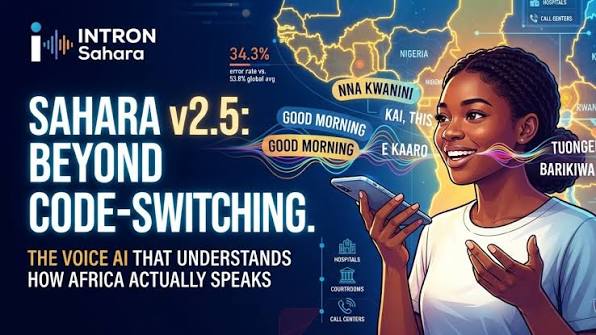
The company unveiled Sahara v2.5 at the 2026 Deep Learning Indaba in Lagos, introducing new capabilities for understanding African languages, accents and natural language mixing.
Sahara v2.5 supports bilingual speech recognition across 12 African language pairs, including combinations involving Hausa, Yoruba, Nigerian Pidgin, Swahili, Zulu and Luganda.
It also includes what Intron describes as the world’s first African trilingual speech-recognition model, capable of following conversations that move between Kinyarwanda, English and French without losing context.
For users, the technology is designed around a reality that is already normal across the continent.
A conversation might begin in English, move into Yoruba to explain an idea, switch to Pidgin and return to English. In another setting, a customer might move between Swahili and English while speaking to a bank or healthcare provider.
Traditional voice AI systems can struggle when this happens, often treating the language switch as an error.
Intron is building specifically for that reality.
The company says Sahara v2.5 now supports a total of 63 languages, while its text-to-speech technology supports 13 languages with code-switching capabilities.
Intron’s published benchmarks also show improvements in recognising mixed-language African speech. ITWeb Africa reported that Sahara v2.5 recorded an average word error rate of 34.3 percent across 12 tested languages, representing a 36 percent relative reduction in errors compared with the global models tested.
The technology is being positioned for practical applications beyond simply understanding speech.
Potential uses include voice banking, customer service, healthcare, education, agriculture, legal services and government services.
Intron says its technology is already being used by organisations including Penda Health, ARM, Branch, Carbon and courts across Nigeria, Kenya, South Africa and Eswatini.
The company has also built a large African speech dataset, with more than six million audio clips contributed by over 70,000 Africans across 13 countries.
For Intron CEO Tobi Olatunji, the opportunity is not simply to make voice AI understand more languages.
It is to make technology understand Africans as they naturally communicate.
That distinction could become increasingly important as voice interfaces become a bigger part of how people access digital services across the continent.
Instead of asking Africans to change the way they speak so that technology can understand them, Intron is betting on the opposite approach:
Build the technology around the way Africans already speak.