



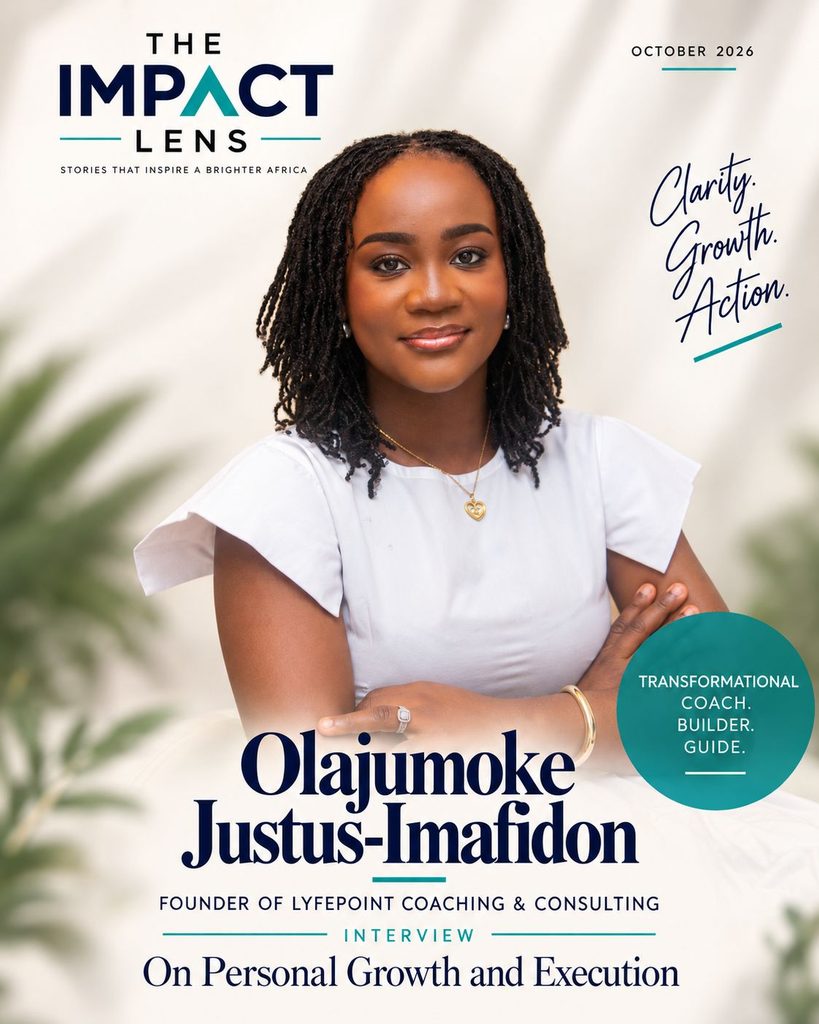
Sometimes, the journey to helping others discover their potential begins with learning to see that potential in yourself. For Olajumoke Justus-Imafidon, that understanding took shape during her time at the University of Lagos, when a first-semester result challenged what she believed she could achieve. Today, as a transformational coach and founder of LyfePoint Coaching & Consulting, she draws on her experiences, professional journey, and Christian faith to help people gain clarity, overcome limiting beliefs, and take intentional steps towards growth.
Having moved from Medical Laboratory Science into data analytics and AI, and eventually into coaching, Olajumoke has learned that growth is not just about recognizing what is possible, but doing the work to make it happen.
In this conversation with The Impact Lens, Olajumoke reflects on the experiences that have shaped her, from learning to see her own potential differently to navigating career transitions and discerning when to wait and when to take action. She shares the lessons her faith has taught her about trusting God’s leading, the importance of building systems that support personal growth, and why she believes that becoming the person you desire to be requires more than good intentions. It requires the courage to take the next step, even when the full picture is not yet clear.
TIL: Olajumoke, who are you beyond the titles, the businesses, and the work? What is the personal story that best explains the woman you have become and what drives you?
Beyond the titles and the work, I am a child of God who is deeply in love with Jesus and passionate about becoming all that God has created me to be, while helping others discover and become all that He has called them to be.
One of my earliest memories that shaped this desire was from Sunday School as a child. I remember admiring my teachers and wondering how they had remained so consistent in their faith. I wanted to become like them, so I followed their example and submitted myself to their teachings. Over time, I began to notice that I, too, was becoming more consistent in my walk with God.
I have learnt that becoming who you desire to be begins with learning from people who embody the qualities you admire and intentionally putting those lessons into practice. That pattern has continued throughout my life. My faith inspires my pursuit of growth, and my desire is to help others experience that same journey of becoming. I want to see people discover their God-given potential, grow into it, and live lives that reflect who they were created to be.
TIL: You studied Medical Laboratory Science, moved into data analysis and AI, and are now building a career in transformational coaching. These are very different professional paths. What happened at each turning point that made you decide it was time to move in a new direction?
Although these career paths may appear different, I have come to see them as building blocks that have shaped the way I work and the value I bring to people. At their core, they are connected by a common thread: helping people find answers, make better decisions, and achieve better outcomes. The tools are just different.
My transition from Medical Laboratory Science to data analytics began in my final year at university. I needed to analyze the data for my final-year research project but could not afford to pay a data analyst. I turned to my best friend, who already had some knowledge of data analysis, and combined what I learned from that interaction with resources I found online. I eventually analyzed my research data and earned a distinction in my project.
Beyond the academic result, I discovered how satisfying it was to make sense of seemingly disconnected data and use it to answer research questions. I started helping my colleagues and other researchers with their analyses, and what began as a practical necessity gradually developed into a career. I continued to learn, upskill, and take on more analytical work, eventually expanding into data analytics and AI-related projects.
Coaching developed differently. For years, I found myself informally helping people think through their challenges, recognize their potential, and take steps towards becoming better versions of themselves. Early in 2026, I had a moment of clarity: I needed to give this aspect of my work more deliberate attention and build it into a practice. Today, as a transformational coach, I help people gain clarity, identify limiting patterns and mindsets, experience growth, and move from vision to execution. My background in data analytics and AI also helps me approach coaching with structure, critical thinking, and a strong focus on practical outcomes.
Each career has contributed something valuable to the next. Medical Laboratory Science sharpened my attention to detail and precision. Data analytics taught me to investigate, identify patterns, and draw meaningful insights. Coaching allows me to apply these skills to human growth and development. I see each stage of my journey as part of a larger story of helping people become better equipped to achieve meaningful outcomes.
TIL: You founded LyfePoint Coaching & Consulting around the idea of helping people experience transformation, growth, clarity, and execution. What inspired you to build this practice?
When I began my undergraduate studies at the University of Lagos, I was surrounded by very bright students, and I did not think I could compete with them. I lowered my expectations and simply aimed not to fail. However, at the end of my first semester, I had a perfect GPA and distinctions across all my subjects.
That experience changed how I saw myself. I realized that the potential I had admired in others was present in me, too. I eventually graduated with a first-class degree and went on to pursue other opportunities that once might have seemed beyond what I imagined for myself. That experience helped me understand how limiting our perception of ourselves can be. Sometimes, we are so focused on what others can do that we fail to recognize what is possible within us. Over the years, this realization has strengthened my desire to help people discover and maximize their potential. I have come to believe that many people are capable of more than they currently realize, but they need the right questions, perspectives, support, and systems to help them move forward.
That is part of what inspired me to build LyfePoint Coaching & Consulting. My goal is to help people discover who they are, understand what they are capable of becoming, and take intentional steps towards that reality. For me, transformation is not simply about seeing a better future; it is about becoming equipped to live it.
TIL: You have pursued different interests and taken on different roles over the years. Looking back, how have you come to distinguish between what you are good at, what you genuinely want to do, and what you believe you should be doing? Has that distinction changed the way you make decisions about your life and career?
I have come to distinguish between these three through an understanding of my giftings, assignments, and timing.
My giftings help me recognize the things I am naturally inclined towards and the areas where I can make meaningful contributions. My desires also matter because they reveal the things I am drawn to and the work I find fulfilling. However, I have learned that being good at something or wanting to do it does not automatically mean it is what I should prioritize at every point in my life. That is where the question of assignment and timing becomes important to me. I believe there is a difference between what I can do, what I want to do, and what God is asking me to give my attention to in a particular season.
My spirituality and relationship with God play a central role in helping me navigate that distinction. I seek His leading as I evaluate opportunities, responsibilities, and the direction I should take. This understanding has significantly influenced how I make decisions about my life and career. I do not see my career as a separate entity from my purpose or the other dimensions of my life. Instead, I consider how my choices align with the person I am becoming, the assignment I believe God has entrusted to me, and the season I am in. It also reminds me that I do not have to pursue every opportunity simply because I am capable of doing so. Sometimes, discernment means recognizing what deserves my attention now and what I may need to leave for another season.
TIL: In August 2026, you created The Execution Lab, while also building LyfePoint Coaching & Consulting. From your experience working with people, what are some of the biggest struggles that keep people stuck, and what practical steps can they take to move forward?
One of the biggest struggles I have observed is procrastination, which can sometimes be rooted in an underestimation of one’s own abilities.
Many people have an idea of what they want to do or where they want to be, but they keep waiting for the perfect time or the perfect version of themselves to emerge before they begin. They convince themselves that they need more knowledge, more experience, more confidence, or better circumstances before they can take the first step. As a result, their vision is continually postponed to a future in which they hope to feel more ready.
I believe there are three important steps people can take to begin moving forward.
First, they need to examine the beliefs guiding their decisions and actions. Our mindsets influence how we interpret our abilities, respond to challenges, and approach opportunities, sometimes without our even realizing it. We must be willing to question beliefs that keep us small and replace them with more accurate, constructive perspectives about ourselves and what we can learn to do.
Second, we need accountability. Accountability does not make you weak; it makes you wise enough to recognize that progress is easier to sustain when you have support. This could mean setting clear goals, establishing deadlines, tracking your progress, or working with someone who will challenge you to follow through on your commitments. Coaching is one of the structures that can help people build this kind of accountability.
Third, we need to be intentional about our environment. The people we spend time with, the ideas we expose ourselves to, and the systems around us can either reinforce our limitations or encourage our growth. Surrounding ourselves with people who are actively pursuing the kind of growth we desire can expand our perspective and challenge us to take action.
Ultimately, you do not have to feel completely ready before you begin. You can start with what you know, learn as you go, and build the capacity required for the vision ahead of you. Sometimes, the next step is not to prepare indefinitely but to take the step you are already equipped to take.
TIL: As someone who helps others pursue growth and take action, you must also have moments when you are figuring things out yourself. What has been one of the most difficult lessons you have had to learn about your own growth, and how has it changed the way you approach life today?
One of the most important lessons I have learned is that growth becomes much harder and slower when there are no clear goals or systems to support it.
I have come to understand that genuinely wanting to grow is not always enough. You can have the right intentions, desire a different outcome, and even know what you need to do, yet still struggle to make consistent progress if your daily habits, environment, and systems do not support the change you want to see. This has made me more intentional about how I structure my life. Rather than relying solely on motivation, I try to establish goals, routines, and practical systems that make it easier to follow through on what matters to me. I have also learned to pay closer attention to my environment and to make adjustments where necessary so that it supports, rather than undermines, the growth I desire.
It has changed my understanding of personal development. Growth is beyond becoming more knowledgeable or having greater aspirations; it is also about creating the conditions that make consistent progress possible. This understanding has influenced how I approach my own goals and how I support others through coaching. I want people to leave with more than inspiration. I want them to have the clarity, structures, and practical steps that help them translate their intentions into meaningful progress.
TIL: Your faith plays an important role in your life. How do you discern the difference between a season that requires patience and one that requires you to take a different direction? Have your experiences ever challenged your understanding of what it means to trust God’s leading?
My relationship with God is central to how I discern the difference between waiting and taking a new direction. I rely on His leading and seek to understand what He is saying concerning the different areas of my life.
One of the questions I ask myself is whether there is an instruction God has already given me that I have not acted on. Sometimes, what appears to be a season of waiting may actually require obedience to something I already know I should do. I therefore try to be mindful of any outstanding instruction rather than assuming that I need an entirely new direction before I can move forward.
Where I have no outstanding instruction and have not received further direction, I continue to wait on God. For me, this is an expression of trust in God’s wisdom and timing.
My experiences have certainly challenged and deepened my understanding of what it means to trust God’s leading. However, those experiences have also pushed me to grow in my knowledge of Him. I have learned that difficult or uncertain seasons can become opportunities to know God more deeply and strengthen my confidence in His faithfulness. The more I grow in my relationship with God, the more I learn to recognize His leading. I may not always understand the full picture at once, but I continue to trust Him as I seek His direction and remain attentive to what He is asking of me.
TIL: You have written a book, built communities, and developed programmes around personal transformation. Beyond the visible achievements, what have these experiences taught you about leadership, consistency, and the sometimes-unseen work required to build something meaningful?
I’ve learned that leadership begins with me. Before I can effectively lead others, I must learn to lead myself. I have become increasingly conscious of the importance of self-governance, personal discipline, and taking responsibility for my own growth. If I cannot lead myself well, it becomes much harder to lead others effectively.
I have also learned that consistency produces a kind of compound interest on our efforts. It turns seeds into fruit, sharpens our skills, and prepares us for opportunities that may not yet be visible. Many of the things people eventually celebrate as achievements are the results of small, repeated actions that were not particularly impressive or visible when they were happening.
Building anything meaningful requires a willingness to do the work that may never receive applause. There is the thinking, learning, planning, refining, and starting again when things do not go as expected. These parts of the process may be invisible to others, but they often determine whether what we build has the substance to endure. I have come to appreciate that the unseen work is not merely preparation for the results; it is part of what gives those results their foundation. Visibility without substance can be difficult to sustain.
For me, meaningful leadership and impact require more than the ability to inspire people or produce visible outcomes. They require the discipline to keep growing, the consistency to keep doing the work, and the willingness to build a strong foundation even when no one is watching.
TIL: When you look at your journey so far, is there a decision, experience or season that you understand differently today than you did when you were going through it? What has hindsight helped you see about yourself, your choices or the direction your life has taken?
Yes. Looking back, I can identify seasons of significant lack that I understand very differently today.
At the time, I sometimes wondered whether I was doing something wrong or whether there was something about my choices that had predisposed me to those circumstances. It was difficult to see beyond the immediate reality of what I was experiencing.
With hindsight, however, I can recognize how those seasons shaped me. They taught me contentment, deepened my dependence on God, and helped me develop greater empathy for people experiencing difficult circumstances. I am more conscious of the fact that people carry experiences others may never fully see or understand. Having received comfort from the Lord in my own difficult seasons, I want to extend that same comfort and encouragement to others. I may not always have an immediate solution to someone’s situation, but I understand the importance of offering empathy and the reassurance that a difficult season does not have to be the end of their story.
TIL: Finally, imagine you are in a room filled with younger women who are trying to build their careers, navigate life transitions or find their footing after an unexpected disruption. Some may be starting over, questioning their abilities or wondering whether they are on the right path. What would you say to them about navigating change, making difficult decisions, and trusting themselves enough to keep moving forward?
I would remind them that life is not always linear. There will be seasons of waiting, seasons of exponential growth, and seasons of transition. You may find yourself having to reconsider a direction you once felt certain about, begin again after a disappointment, or discover that you are being drawn towards something different from what you originally imagined.
None of that means you have failed, and it certainly does not mean you have to remain the same person or stay in the same place for the rest of your life.
My advice would be to follow God’s leading, remain faithful with what is in your hands today, and stay open to what may be next. You do not have to understand your entire journey before you take the next step. Sometimes, clarity comes as you move. As you take those difficult steps, learn from your experiences, and respond to the opportunities before you, the next phase begins to take shape.
I would also encourage them not to underestimate themselves. Do not allow the fact that you have never done something before to convince you that you cannot learn to do it. You may need to acquire new skills, seek guidance, adjust your approach, or give yourself time to grow, but you do not have to remain confined to your current level of knowledge or experience.
Most importantly, do not let the fear of failure keep you from pursuing what matters to you. Failure can be painful, but the regret of never giving yourself the opportunity to try can be even more painful. Your previous experiences, including the difficult ones, can become resources for the next chapter of your life.
It is never too late to start again. Be faithful with where you are, trust God to lead you, and have the courage to take the next step even when you cannot yet see the entire path ahead.