
Peace is often described as the absence of conflict.
But for Dr. Prince Eze, peace is much more than silence after violence. It is the presence of justice. It is security that protects the vulnerable. It is development that reaches the margins. It is governance that works for the people.
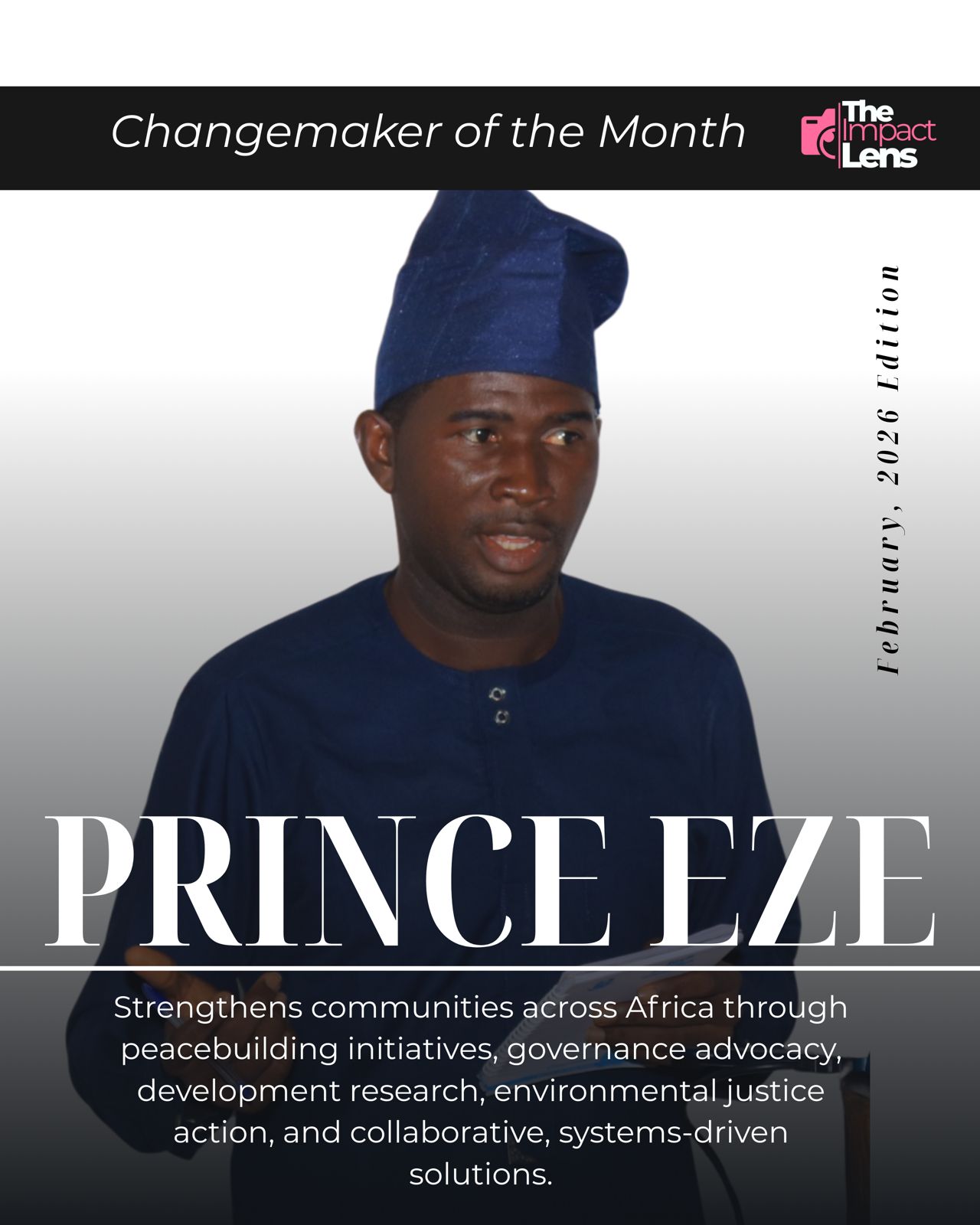
This month on Impact Lens, we spotlight a scholar whose life’s work sits at the intersection of research, policy, and grassroots transformation.
Dr. Prince Eze is not only a distinguished academic. He is a systems thinker, a bridge builder, and a development practitioner committed to advancing good governance, environmental and gender justice, and sustainable peace across Nigeria and Africa.
As a Lecturer at Ignatius Ajuru University of Education in Port Harcourt and a Research Associate at the University of Johannesburg, South Africa, Dr. Eze operates in spaces where ideas are shaped and refined. He holds a Master’s degree and a PhD in Development Studies, grounding his work in rigorous academic research.
But what distinguishes him is not just scholarship. It is application.
Dr. Eze believes research must leave the classroom. It must speak to real people, real communities, and real challenges. That conviction led to the founding of the Hope for Tomorrow Initiative, also known as the HOFTI Centre.
Through HOFTI, he translates theory into practice. Governance into accountability. Peacebuilding into lived experience.
Building More Than Projects
Since 2010, Dr. Eze has led over 25 initiatives focused on peacebuilding, governance reform, environmental sustainability, youth empowerment, and development policy engagement. These programmes have reached and benefited more than 3,000 individuals, including young leaders, vulnerable groups, policymakers, and community actors.
Under his leadership, the HOFTI Centre has grown into a respected platform for dialogue, training, research dissemination, and policy advocacy. It operates as both a think tank and a grassroots connector, ensuring that policy conversations reflect community realities.
His approach is deliberate. Sustainable peace cannot exist without good governance. Development cannot thrive without justice. Environmental degradation cannot be separated from social instability. Everything is connected.
And so his work is interconnected.
Dr. Eze is also an author whose contributions extend into secondary education. Two of his books, Study Guide and Strategies and Career Options, were approved by the Rivers State Ministry of Education for use in Senior Secondary Schools in 2017.
For him, education is not just academic advancement. It is empowerment. It is preparation. It is a foundation for ethical leadership and informed citizenship.
His academic publications in national and international journals further reinforce his influence in development studies, peace research, and governance discourse.
Dr. Eze’s work has earned him notable recognition. In 2019, he received the prestigious PhD Right Livelihood Workshop Scholarship. In April 2022, he was admitted as a Fellow of the United States Institute of Peace. In May 2024, he received the Omega Resilience Award with funding support to implement a development project in the Niger Delta. In 2025, he was admitted as a Rise-Up Together Fellow.
These recognitions reflect a consistent pattern: research that informs action, and action that produces measurable impact.
Yet recognition has not shifted his focus. His commitment remains rooted in systems change, capacity building, and collaborative engagement.
Dr. Eze consistently emphasizes that peace is not merely the absence of violence. It must include justice, equitable development, accountable institutions, gender inclusion, and environmental responsibility.
This holistic lens shapes his leadership. It shapes his research. It shapes the initiatives he leads.
Whether facilitating policy conversations, training young peacebuilders, engaging civil society networks, or mentoring students, his work is guided by one principle: sustainable development requires ethical systems and informed citizens.
Beyond his professional accomplishments, Dr. Eze is a husband and father. He is married to Mrs. Rita Prince-Eze, and together they are raising two children, David and Davina. His commitment to family reflects the same values he promotes publicly: responsibility, integrity, and long-term vision.
At Impact Lens, we highlight individuals whose work strengthens institutions, uplifts communities, and shapes policy with integrity.
Dr. Prince Eze represents a form of leadership that is thoughtful, grounded, and forward-looking. He does not chase quick wins. He builds frameworks. He strengthens systems. He equips people.
In a world where development conversations can often become abstract, his work reminds us that peace and governance are not distant ideals. They are daily responsibilities. They are structures we must intentionally design and sustain.
This month, we celebrate Dr. Prince Eze for advancing justice, strengthening governance, and building sustainable peace through research, education, and practical action.
That is impact worth amplifying.